




A Day of Honor in Normandy
-Today I was given the honor to place the flowers at the memorial in the American Cemetery in Normandy, France.
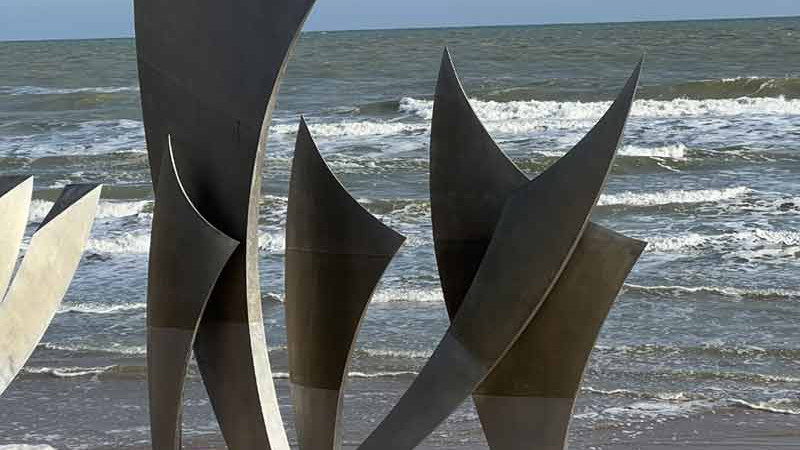
Our first stop was Omaha Beach in Normandy. There are two beautiful memorials at the beaches.
The second stop was Pointe du Hoc which was the German stronghold. I was able to climb in the bunkers and explore them.
The American rangers climbed the sides of the cliffs to dismantle the guns. Because of the darkness they missed the exact area they were supposed to climb. They then engaged in battle with the Germans, and unfortunately help was not able to come quickly.
A lot of things went wrong in the invasion because of the weather and the rough seas. They were not able to land exactly as they planned back in England on dry land mapping out the invasion.
As the day and the battle progressed new plans were being made. Before the invasion, there was a lot of bombing to distract the Germans exactly where we were going to do the landing, and it was hopeful to put the German guns out of commission. The bombing did not succeed.
Only one house in the village of Normandy did not suffer from the bombing. We saw one church built during the time of William the Conqueror that received some damages and has since been rebuilt.
The most moving part of the day was when we visited the American cemetery. Normandy is a city of cemeteries. There are three German cemeteries; there are 18 for the British, Canadians, and the Commonwealth members.
The largest cemetery is the American—over 70 acres. Each family received a letter asking if they wanted their family member returned to the United States or to remain in France. The cemetery was completed in 1956.
The stories of our heroic dead is endless. There are 40 brothers buried side-by-side. One father and son. There are three Medal of Honor winners.
Brigadier General Theodore Roosevelt Junior insisted on leading his men into battle in the Normandy invasion. He walked with a cane because of arthritis. He survived two days of battle before he died of a heart attack. Teddy Roosevelt Junior was the oldest son of President TR.
At the request of the Roosevelt family, TR’s youngest son Quentin, who died in World War I when his plane crashed and was buried in a different French cemetery, was moved to be buried next to his brother in the American cemetery in Normandy. TR Junior received the Medal of Honor after his death and has a gold star on his cross.
You are not allowed to walk among the graves. If you wish to visit a particular grave, you must be escorted by a member of the battlefield commission. There was a woman in our group whose uncle is buried in the American cemetery, and she was taken to his grave.
The memorial where I placed the flowers is the statue of a youth coming out of the ocean to represent the young who gave their lives. The average age in the cemetery is 24; the youngest is 17. I don’t know how old the oldest is. I’m thinking it was TR Junior.
At the ceremony, we sang the national anthem terribly. I placed the flowers at the foot of the memorial statue, then taps were played.
After the cemetery all the veterans in our group stood beside me to have our picture taken. I was the only woman among a lot of very old men. God bless them all.
The day was beautiful, it was sunny. The weather in Normandy is normally not sunny. It was still bitterly cold with heavy winds.
They have a beautiful non-denominational chapel in the middle of the cemetery.
The crosses and stars of David are painted regularly to keep them pristine. I saw a man painting a star of David.
The gardeners trim the trees by hand with scissors. It takes them three days to do one tree.
There were lovely flowers around the trees. There are no flowers on the graves.
The people of Normandy have not forgotten our sacrifice.
After the invasion, the Germans knew they were losing the war so they became crueler.
Our local tour leader Geraldine told the story of her grandfather who was mayor of a small town near the Swiss border. The men were rounded up and were going to be shot because the Germans thought there was Morse code coming out of the bell tower of the church. The grandfather insisted there was no Morse code coming from the church. The men were not shot. They were marched away to a camp near the town. The only man to die on the march was the village priest.
The town was liberated shortly and the men were never shot. The grandfather investigated the bell tower in the church and found an owl living in the bell tower feeding her babies. He believes it was the owl hooting going in and out of the bell tower that made the Germans think it was Morse code. I don’t understand why they didn’t go up into the bell tower.
Our local guide at the cemetery has a grandfather who lost 20 members of his family. From the sounds of her story I think she may have been Jewish. Several members of her family were saved by other Frenchmen.
The movie Saving Private Ryan is based on a true story, except his name was not Ryan. I did not know it was based on a true story. I did see the movie and when I get home, I plan to watch The Longest Day and Saving Private Ryan again.


Leave a comment